

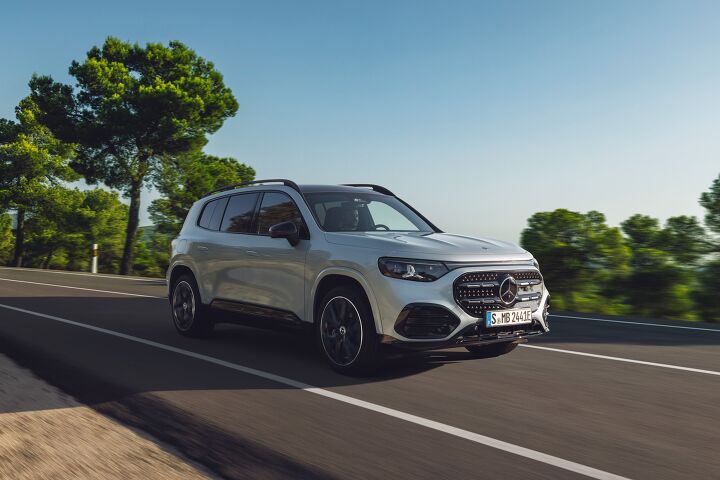
Mercedes-Benz has revealed the all-new GLB for the 2027 model year. Slightly larger than the GLA, the forthcoming GLB’s primary function seems to be giving customers the option of third-row seating in a crossover package that resembles the significantly more expensive GLS SUV. However, the model will likewise offer a staggering number of powertrain configurations once production is sufficiently spun up.
Based heavily on the brand’s similarly updated CLA sedan, the GLB likewise rides on the “Mercedes Modular Architecture” (MMA). This means there will be an array of powertrain options, including hybrid models that are scheduled to manifest after its initial launch. It also means customers will have the option to select between front, rear, or all-wheel drive. This is new for the GLB, which was formerly a front-wheel drive model with the ability to option Mercedes’ 4Matic all-wheel drive system.
As the GLB effectively serves as the brand’s replacement for the EQB, it will launch exclusively as an all-electric model. The base model GLB250 will be rear-wheel drive 268 horsepower and 247 lb-ft of torque utilizing a two speed transmission. Meanwhile, those wanting all-wheel drive and perhaps can have the GLB350 4Matic’s dual-motor setup yielding a combined 349 hp and 380 lb-ft.
Of the two GLBs using Mercedes’ EQ electrified tech, the GLB250 is supposed to reach 60 mph in roughly 7.3 seconds, whereas the all-wheel-drive GLB350 is said to achieve the same in just 5.4 seconds.
As expected, the peppier and heavier GLB350 loses out on range. While the GLB250 is supposed to achieve an estimated 330-390 miles on a full charge, the GLB350 should be closer to 320-380 miles. This is down to both units using a 85-kWh, nickel-manganese-cobalt battery. However, those estimates are using the European WLTP test cycle that tends to overestimate the real-world range customers end up seeing. We’d lop off about 10 percent of that maximum range if you want to know where the EPA-estimated figures are likely to land.
Still, those aren’t bad figures from EVs and Mercedes-Benz has said the GLB and its 800-volt battery architecture will allow for up to 320 kW on an 800-volt charger. That’s supposed to be enough for the vehicle to recoup over 150 miles of range in about ten minutes. That’s pretty impressive, even if we all know that constantly fast charging a vehicle isn’t great for its battery life. But most drivers will be doing the brunt of their charging more slowly at home and the automaker has said the car will be sold with an adapter to allow it to make use of older charging ports.
The standard port is the now-ubiquitous NACS type used by Tesla Superchargers. Meanwhile, the CCS-type adaptor should keep you covered most everywhere else.
Hybrids aren’t scheduled to arrive after the EVs have had some time to themselves and Mercedes-Benz hasn’t offered up as much information on those yet. However, due to the GLB’s connection to the new CLA, we can look to the latter to make conclusions about the former.
Expect a 1.3-kWh lithium-ion battery and small electric motor working in tandem with a 1.5-liter four pot. While all-electric propulsion will be available, the stints will be short and the top speed of running the car as an electric will likely be limited to just 60 mph. We also expect the GLB to borrow the sedan’s eight-speed dual-clutch automatic. Base models should be front-wheel drive, with customers having the option to pay more for 4Matic all-wheel drive.
On the CLA, this setup is supposed to yield a grand total of 208 hp and 280 lb-ft which is good for launches to 60 mph in the low 7 second range. But the GLB will probably be a bit slower due to the extra weight.
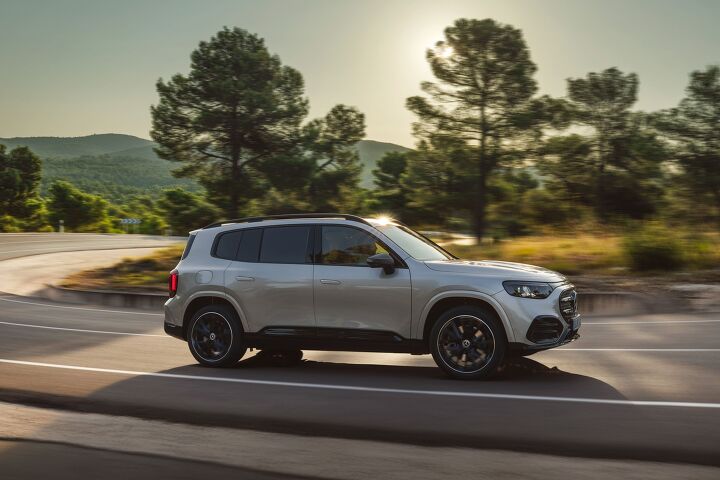
However, we don’t expect most GLB shoppers to be preoccupied with speed. They’re likely interested due to the badge appeal, technology, and added interior space. While the redesign hasn’t drastically altered the overall aesthetics of the model, the GLB has been resized to accommodate more items inside.
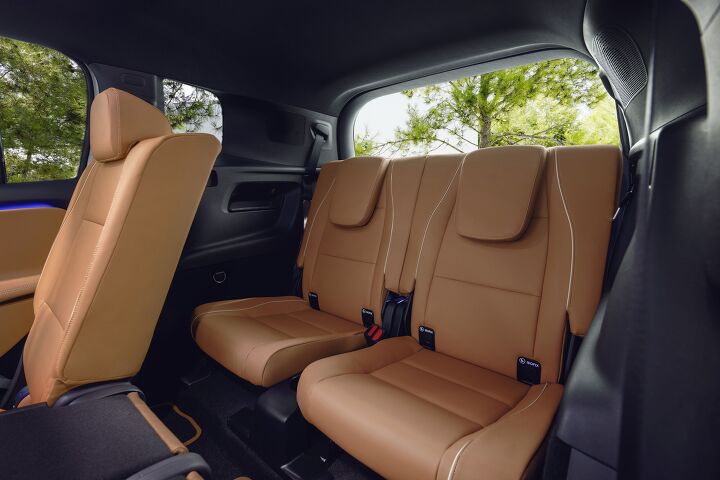
It’s now almost 4 inches longer and about an inch wider than the outgoing model, resulting in a tad more space just about everywhere inside. Customers are getting a smidgen more shoulder and legroom just about everywhere. However, the automaker did opt to lower the roof slightly (presumably to give it a sleeker look), potentially robbing occupants of the optional third row of some headspace.
This probably isn’t the end of the world if you plan on filling that area with small children or dogs. However, smaller three-row vehicles are always in an impossible battle with themselves on how exactly to balance their size with interior volume. Mercedes has attempted to cope with this by making it easier for passengers to get in and out of the back portion of a GLB they’ve also made slightly larger overall.
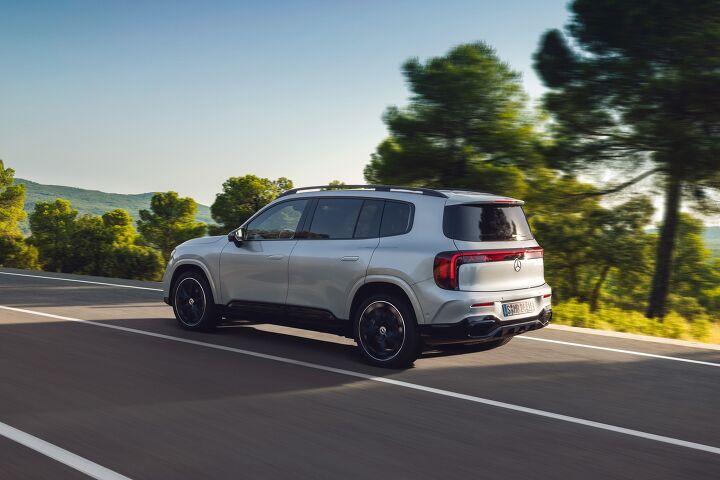
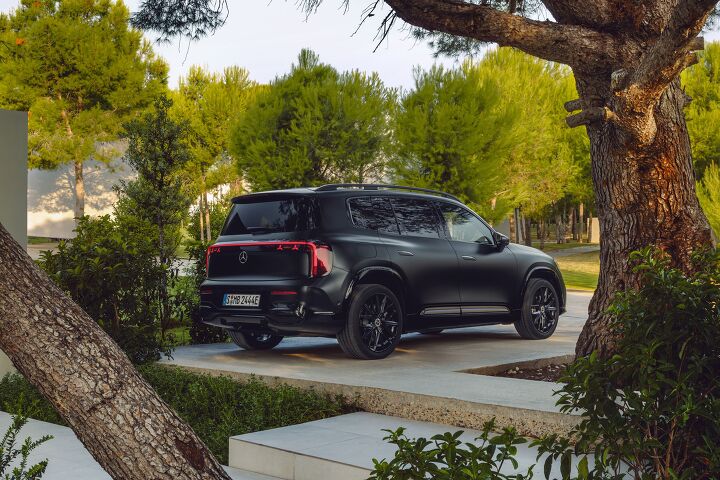
In terms of exterior design, the 2027 model year is even boxier than before (at least from the side profile) and has adopted some of the modern lighting cues we’ve seen from other MB vehicles. We’re especially noticing the star headlamp running lights and oversized grille.
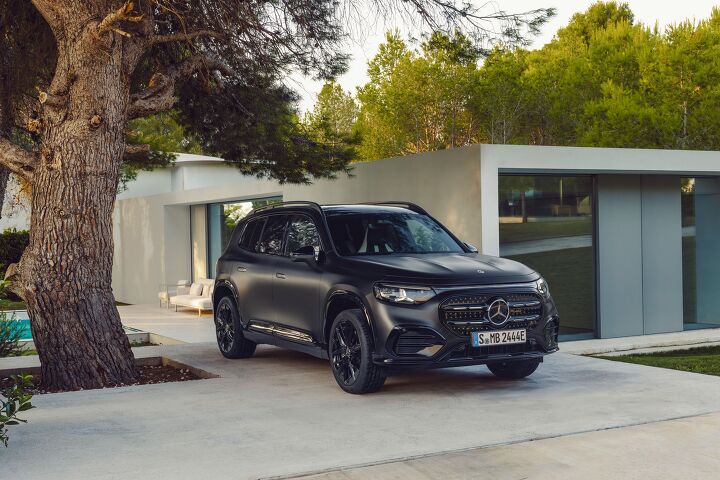
At the back, Mercedes has opted to dump the old GLB tail lights for LEDs that run across the entire rear before swooping down toward the bumper. It feels like an amalgamation of select Audi and Volvo models. Granted, the CLA sedan also adopted wide LEDs at the rear. However, the execution was quite a bit different and clearly designed to be a continuation of the EQB design language.
Mercedes is doing something different with the GLB and our guess is that it all comes down to the company having already developed a successor to the EQB EV. While it’s no longer technically going to be selling us the EQB, the car effectively lives on in the updated GLB.
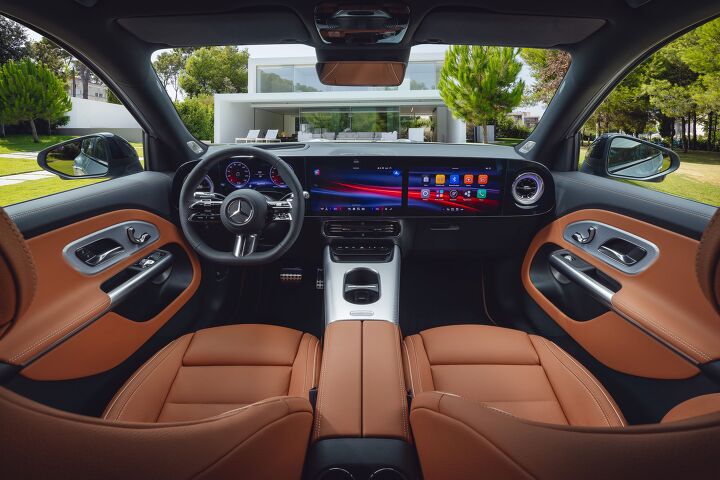
Inside, customers will notice that Mercedes continues leaning into screen-focused cabins. But buyers are given the option to go absolutely nuts by way of an optional “Superscreen.” While the 10.3-inch digital driver display and a 14-inch central touchscreen will always be standard, opting for the Superscreen adds another 14-inch display for the front passenger. Those with family members that are prone toward getting carsick while looking at their mobile devices may want to opt out of this setup.
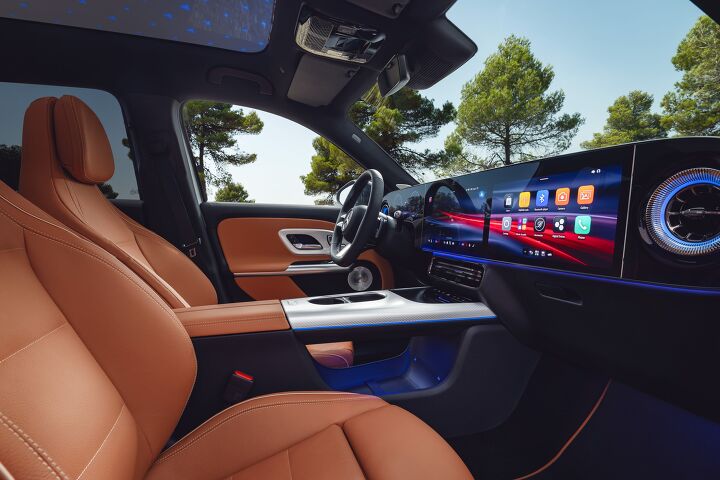
Fortunately, Mercedes-Benz seems to have caught wind that people aren’t finding touch-controls all that luxurious anymore and has included a few essential buttons, similar to what we’ve seen on the updated CLA. Still, most of these look to be relegated to the steering wheel.
The automaker clearly wants you to interface with the vehicle in other ways, namely the AI virtual assistant. If you’re a big fan of voice controls, Mercedes is supposed to have you covered. While your author would prefer physical controls, the automaker is dead set on dazzling you with tech and pushing customers to use app-based features while interfacing with the latest virtual assistant fitted to the MBUX infotainment system.
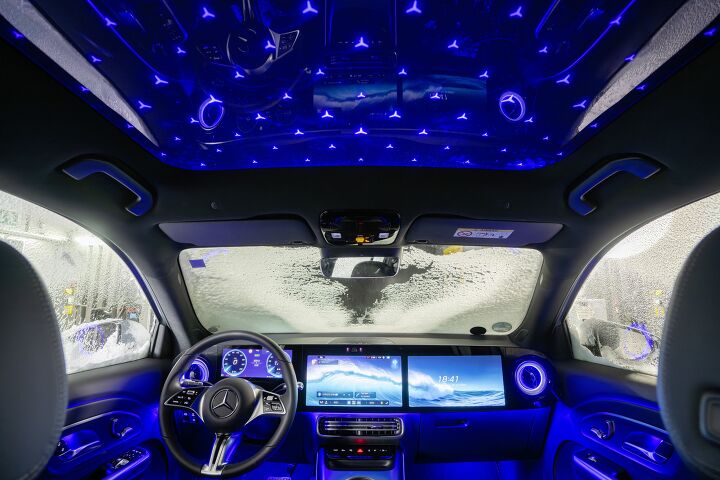
Additional tech features that are clearly there to entice people visiting the showroom are the now-standard panoramic sunroof — which can be optioned with a faux night sky featuring a bunch of baby Mercedes-Benz logos as stars. Known as Sky Control, it’s quite possibly among the automakers most tacky inclusions. However, it does allow drivers to instantly control the opacity of the roof. So it does have a more practical use case.
We’ll have to wait to test the EV and hybrid to see exactly how the improved cargo capacity and passenger room works out. But it seems like Mercedes is offering a more useful interior while also leaning deeper into some of the more polarizing tech trends.
There will be loads of tech options you can upgrade (or presumably subscribe to) via over-the-air updates. As for the practical options, Mercedes plans on letting customers buy an adaptive suspension that’s ready make life more comfortable or sporty on demand. There’s likewise a mode to let the car choose the suspension setup based on what it thinks is best.
Ambient lighting options likewise remain robust with the company giving customers an opportunity to turn the cabin into a their own portable night club. Advanced driving assistance features will also be available, even if the base GLB is supposed to come with the essentials thanks to it boasting “eight cameras, five radar sensors, 12 ultrasonic sensors and a water-cooled high-performance supercomputer.”
Optional ADAS features will include lane keeping (with steering assist), stop light and traffic sign identification, parking assist, and a 360-degree camera display when you’re keen to avoid scratching the paint while maneuvering in a tight space.
The electric models aren’t supposed to show up on our market until winter of 2026, with the hybrids likely showing up months later, so pricing has not been decided. But it seems plausible that the electrified GLB will cost roughly what you’d expect from an updated EQB. That should ballpark somewhere around $56,000. Meanwhile, the hybrid models should start a little shy of $50,000 to ensure that pricing doesn’t conflict with the smaller GLA or larger GLC.
Obviously, those are just to start. Mercedes-Benz will certainly let customers climb the trim ladder for thousands more, which will translate to tens-of-thousands once the automaker offers the high-performance AMG variants.
[Images: Mercedes-Benz]
Become a TTAC insider. Get the latest news, features, TTAC takes, and everything else that gets to the truth about cars first by subscribing to our newsletter.
